
What Is Horror Poetics? Part VII: Monster Hunters, Monster Lovers, Monster Fuckers
Or why Freddy still scares us even though we have the plushie
by J †Johnson
Life’s a spoiler, and we can’t talk about popular culture or media theory without a content warning (and for good reason). This installment of What Is Horror Poetics? discusses sexual predation in culture and in horror cinema, so please proceed with appropriate caution, should you choose to go there with us. We hazard that horror requires discretion and self-consideration, even as our engagement with horror media, for many of us, is a complex form of self care. The world would be unbearable without horror films, books, and poetics.
There is a dynamic in these three positions—monster hunter, lover, fucker—that functions something like Jack Halberstam’s gothic monstrosity generator in Skin Shows. Whereas Halberstam focuses his argument on the hybrid Gothic novel (of which epistolary forms in Frankenstein and Dracula are exemplars), we’re thinking of hybrid and cross-media as well as cross-cultural formats. These are ongoing concerns we’ll likely be unpacking for years, but we turn our attention now to the problematic, charismatic, predatory cinematic monster of which Fred Krueger is perhaps the best example. That said, we can trace this archetype back to Robert Wiene’s The Cabinet of Dr. Caligari (1920), F. W. Murnau’s Nosferatu (1922), and Fritz Lang’s M (1931), to cite three significant, early examples that engage monster hunter/lover/fucker tropes.
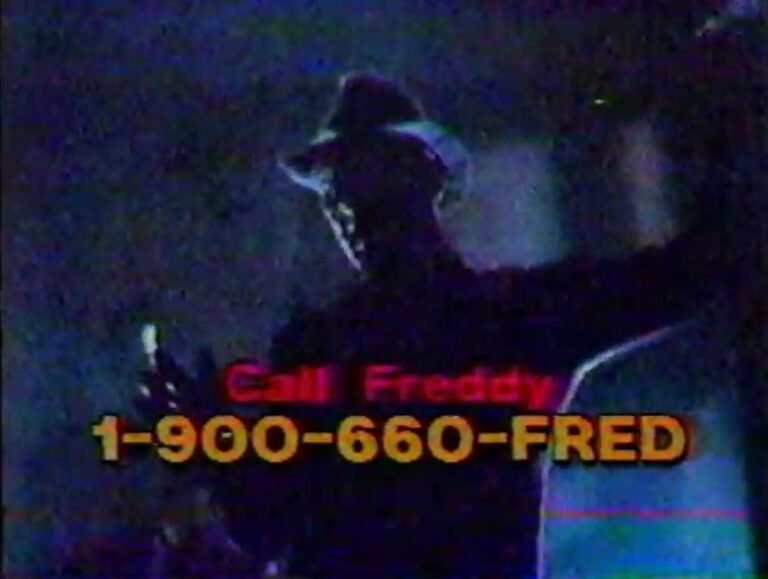
For all the mainstream pop culture acceptance Freddy eventually finds (and what is the name Freddy but a friendly version of Fred?), he is essentially and originally a child killer. Also, as Peaches Christ, Michael Verrati, and Darren Stein point out on the Nightmare on Elm Street episode of the Midnight Mass cult movie podcast, and Mike Muncer and Stacie Ponder remind us on the Evolution of Horror podcast (see the “EOH Revisited” Slasher episode), the first Elm Street film suggests from the opening scene that Freddy is a sexual predator. We’d love to say popular culture stops short of celebrating child predators, but in an age when the president of the United States is a convicted sexual abuser and some of our most celebrated directors and producers are known pedophiles, we simply can’t make that argument. We are long past the point of open secret or even disavowal, and we now openly celebrate sexual predation. However, this ongoing state of hypocrisy is part of what makes the predator monster such a powerful and potentially subversive archetype. Even if we do stop short of celebrating Freddy the child predator, we can credit the franchise for its moments of and potential for subversive commentary. The potential itself is crucial to queer horror, which is not only a matter of filmmaker intent, but of the ways queer people read (and queer) horror.
Is Freddy particularly scary in the first film because he isn‘t famous and corny yet, or does he get even more terrifying when he embraces dad humor and comic props, threatening to become a beloved prankster who is also a predator? And does that dynamic make him extra dangerous as a queer(ed) horror icon, considering the demonstrably false claims by homophobic and transphobic people of rampant and systematized abuse and grooming as endemic to gay and trans culture? Yes and that’s also part of the subversive power of this archetype. Horror is always a matter of cultural fears exercised and exorcized at any given time (including the time of composition as well as the time of reception). As long as we live in a culture that fears gay and trans people and assumes they are pedophiles, while also protecting and enabling straight men who prey on children as well as vulnerable others, the predator monster archetype will be a powerful horror device. Queer people who revel in this archetype appreciate that potential for social critique, rather than identify with predatory, monstrous desires. Let’s get that straight. And many queer people identify with cinematic monsters because queer people are monstered within culture. The cinematic monster is at least temporarily empowered, whereas social monstering of queer people is always intended to disempower them. So that cinematic identification can at least temporarily, for an act or two in a horror film, restore a sense of (conflicted) agency to a queer audience. It’s complicated and that’s why it stays with us and gives us something to think about. The monster is always in conflict with itself as much as the mob.
Of course, (im)plausible deniability plays into the monster predator archetype. Despite moments where Freddy explicitly sexualizes his threatening gestures (Freddy’s crotch Jaws moment with Nancy in the bathtub, or Freddy sticking his tongue through the phone receiver and into her ear), much of the sexual menace is implied (even if the monstrous blood orgasm that obliterates the odious Johnny Depp in his teenage bed is less than subtle). So we are free to see Freddy as “only” a child killer and not a child molester, just as we can elide the word “sexual” in the term predator monster. In his threatening playfulness, his playful threat, Freddy also becomes a gross uncle of the sort we tend to excuse: he’s fine with kids, just don’t leave him alone with them. Of course, Freddy’s whole M.O. is to get kids alone. This (im)plausible deniability is what grants predators access to their prey on production sets.
Furthermore, this deniability is precisely what is frightening about this archetype, as well as the real world patriarchal monsters who play (nonconsensual) bad daddy. This is the function of subtlety, insinuation, and covert monstrosity in horror. Menace that is not overt is particularly wicked and diabolical in its cultural and psychological manipulation. Such predation is opportunistic, and that opportunity is always on offer by an essentially predatory, exploitative culture. We’re making our point in relation to the threat of sexual violence against children and teens, and it’s important to also acknowledge that similar dynamics apply to any power imbalance involving vulnerable populations (queer and trans people, people who identify as women, poor people, young people in general) subject to oppressive norms.
As for monster fucking, the last couple years gave us overtly sexualized takes on two classic, gothic monsters: Robert Eggers restaged Nosferatu (2024) as a psychosexual duel, and Guillermo del Toro reframed Frankenstein (2025) as an Oedipal love quadrangle. Meanwhile, both of them marginalized the queer motifs we have identified and read into prior versions. (See for example 1975’s The Rocky Horror Picture Show, where monster making and monster fucking are queered all night long.) Of course, monster fucking is inherently queer, and that giant asshole in the middle of Frankenstein’s new lab is wide open for interpretation.
†††
How do we extend our sympathy for the queer monster at the periphery while guarding ourselves from the reactionary, predatory monster inside the gates? How do we develop empathy for the outsider and embrace our own otherness while rejecting the impulse to exile and other? Perhaps we need a new queer teratology. We must distinguish between the self-made monster and the monstered other.
Yet again Mary Shelley’s novel provides a model, whether or not she intended to queer the genre. Victor Frankenstein’s monster functions as a constitutive outside not only in allowing Victor to project his classist and ableist biases upon a creature he can describe as less than human, for the sake of bolstering his own sense of superiority and humanity. As the creature turns violent and vindictive, monstered as it is by Victor and other humans lacking all compassion for a figure they cannot comprehend, that cultivated monstrosity begins to (re)construct Victor’s own progress toward reactionary monstrosity. Just as the creature is horrified by its own reflection because it has been conditioned to see the normative human countenance as beautiful, Victor sees himself mirrored in the increasingly violent and diabolical creature as the outward form of his own ruinous will and disregard for others. It is unclear how Mary Shelley intends us to read Victor’s repeated claims that he himself, rather than the creature, murdered William, Justine, and Clerval. We are inclined upon subsequent rereadings to take his confession at face value: Victor knows he is responsible for the murderous monster he created. He might not understand that he made that monster after he animated it. He knows he raised a living creature from collaged matter and an infernal spark, but he does not recognize that he raised a monster in his treatment of that creature. (For a direct, effective exploration of these themes, see Larry Fessenden’s filmic version, 2019’s Depraved.) Nor does he know how true his self-recrimination rings. The creature, having become monstrous, is the instrument and expression of Victor Frankenstein’s misanthropy and rage. Furthermore, Victor’s fear of the creature spawning a “race of devils” comes true in an extended sense of Halberstam’s novelistic monster generator, when we apply it to media theory: think of Shelley’s Frankenstein as a polyvocal meta-epistolary, and we can imagine the book itself as the monster Frankenstein, which also means all the editions and copies of it are the race of devils Doctor Frankenstein feared. As well, all the cinematic versions Shelley’s novel inspires, and all the creature features James Whale’s Frankenstein generates, give us infinite variations on the monster hunter, lover, and fucker motifs. For many of us, they also fill our homes with more and less snuggly monster toys we collect with care, even as we never lose our fear of the very real killers among us.
Read What Is Horror Poetics? Part I , Part II, Part III, Part IV, Part V, and Part VI.