
Weird Gourd in the Pumpkinhead Patch
by Eric Rivera
Darkness, followed by a rolling explosion of fire. Uncanny evil lurking beneath the surface of a quaint small town. Hormonal teenagers making rash decisions as though possessed by powers they can’t understand. Sinister poetry recited like a voodoo spell. Powerful town leaders ruthlessly protecting their own dark secrets. A disfigured innocent. Violence paired with yearning pop music. Waking from a dream into another dream. An otherworldly stranger intoning: “It is happening again.”
Any of the above sentences could be used to describe scenes in films by David Lynch, the master filmmaker whose surreal art house noirs leave me in an emotional state I usually describe as “always on the verge of—but never quite—figuring it out.” Not literally, of course. The typical mystery is enjoyed twice: first in fear, then in delight. On the first viewing, you are the detective, unsure of where the clues will lead you. During the second viewing, you watch as the killer, aware of every obfuscation, twist, and motive.
Lynch, however, didn’t make whodunits. His mysteries were those of existence, of consciousness, of sex and death and love and fear. If you’re on his wavelength, watching a Lynch movie is akin to waking from a dark dream, the emotions of what your sleeping brain went through seeping into every normal aspect of your waking life, making alien something as mundane as lowering a spoon into a bowl of Cheerios.
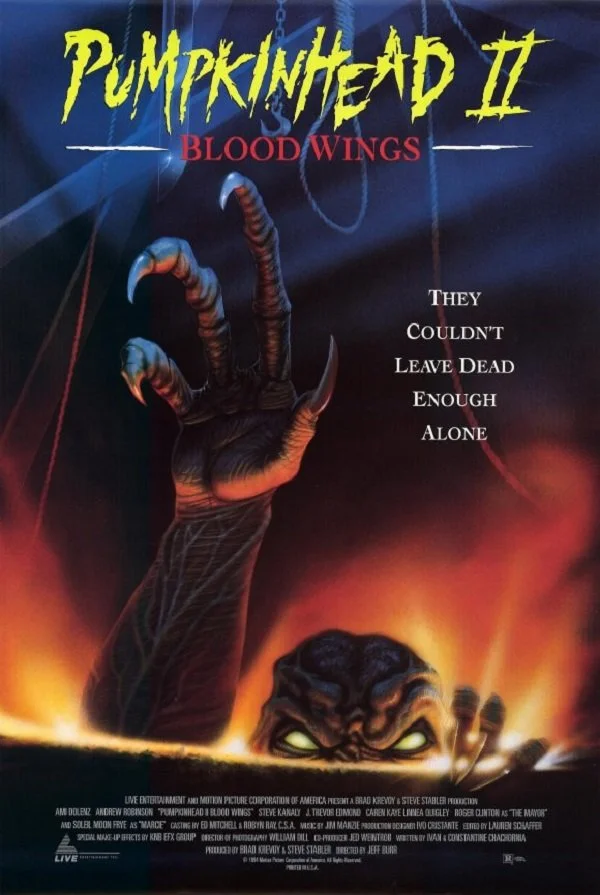
But those opening lines aren’t about Twin Peaks, Blue Velvet, Eraserhead, The Elephant Man, or Wild at Heart. They describe Pumpkinhead II: Blood Wings, the 1994 straight-to-video sequel directed by Jeff Burr.
The original Pumpkinhead is a moody piece of “hicksploitation” horror from 1988 that features a standout performance from Lance Hendrickson (Near Dark, The Terminator, Aliens), and the directorial debut of special effects wizard Stan Winston (The Thing, The Terminator, Aliens). Most critics and fans think it’s the best film in the Pumpkinhead patch, though it never grabbed my attention the way Blood Wings did.
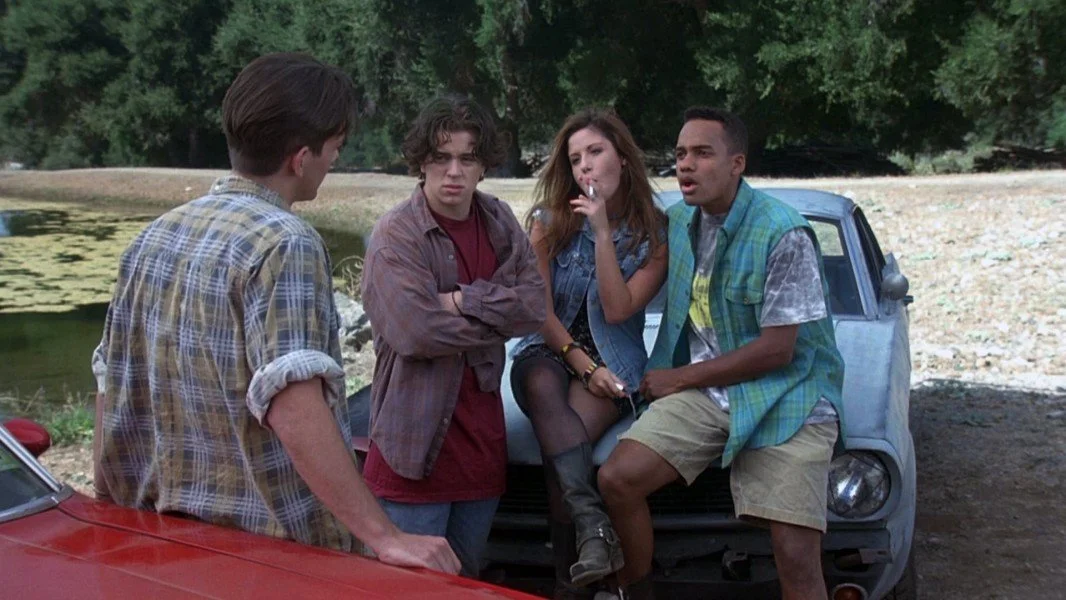
In Pumpkinhead II, Sheriff Braddock returns to his southern hometown to head up the local law enforcement, after a couple of decades in the NYC police department. He moved to get his daughter Jenny out of the city after she’d fallen in with a bad crowd. Jenny immediately falls in with this town’s bad crowd, led by Danny Dixon, the son of the town’s judge.
Danny, Jenny and her new friends cross paths with an old witch named Miss Ossie and inadvertently revive Pumpkinhead, a demon monster who exists solely to exact revenge upon whoever wronged his conjurer. The catch is: Pumpkinhead also kills and eternally damns the soul of the person who called him into being, a literal and spiritual mutually assured destruction. But Pumpkinhead doesn’t go after the teens—at least not yet. He first goes after some longtime residents of the town, for reasons not explained until later in the film.
Sheriff Braddock has no idea what his daughter’s been up to and is trying figure out who is killing the town’s citizens, how the deaths are connected, and why in each crime scene the walls are covered in a bloody “V” symbol.
I’ll be honest: upon first viewing, the opening act didn’t particularly interest me. It’s a small-town story similar to the original film, the acting choices were odd, and the dialogue was a little off. I may have dozed off. Around 30 minutes into it, though, the film’s style came to the foreground. As local man Ernst looks around in fear at his farm as the wind picks up around him, the film cuts to a shot of a sunflower whirligig, the colorful plastic petals spinning maniacally against a black night sky. As Ernst retreats to his barn, we see a different whirligig picking up speed in the wind, a small woodsman sawing a log in a way that’s sexual, like he’s happily humping it with increasing urgency.
I laughed: it was a purely visual gag right before the full reveal of Pumpkinhead, who looks like the lovechild of a Xenomorph and ET. Pumpkinhead then rips the limbs from Ernst, leaving only a torso for the sheriff to find. What makes the scene, though, is the sound design. Ernst assumes he’s fighting Satan himself. As he screams “Come on, Satan” and tries to defend himself with a shotgun, a small radio broadcasts a preacher spouting limp evangelical pieties while the poor farmer screams his last screams.
While this woke up my interest, the next few scenes ignited my obsession with the movie. Sheriff Braddock recites to his wife and the town doctor an old nursery rhyme about Pumpkinhead, which his daughter Jenny overhears. The style shifts again: the film now cuts between dramatic close-ups soundtracked by eerie music. Shortly after, Jenny lays in her frilly bed to sleep. The camera pulls out, revealing her bed is now in an empty field. Her shirtless boyfriend Danny Dixon enters the frame to embrace and kiss her beneath the covers. After a few moments, she wakes up from her sexy dream drenched in sweat, only to realize her bed is still out in the empty field. She looks up and meets the gaze of the monstrous Pumpkinhead. It howls, and she screams until she wakes up back in her room.
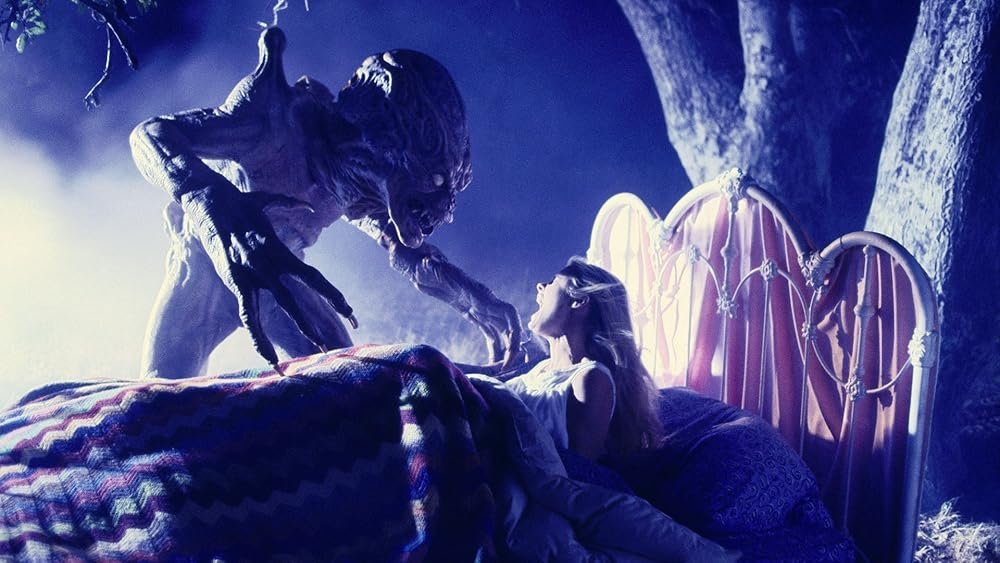
The next scene is easily the best in the film, the one that feels most like a David Lynch movie. Pumpkinhead stomps through the same field from Jenny’s dream to a lone shack. The shack belongs to Red Byers, a large, bald, bearded postman out of a Bukowski novel. He lays on a cot as a topless blonde named Nadine rides him (the film’s only nudity, provided by scream queen Linnea Quigley). A country song plays on a crackling portable FM radio, a 1970s-style ballad with a big pop orchestra backing it up. The two exchange flirty, horny lines with each other, revealing he’s either married or recently divorced due to his relations with the woman on top of him. We’ll later find out he also steals packages from his mail route to resell. As they have their illicit fun, Pumpkinhead moves ever closer to the shack and we see the world through its POV: everything is blood red, the image doubling back and fading into itself, with the sound of buzzing flies ever present. When the fun is done in the love shack, the mailman’s girlfriend walks to his truck to get some cigarettes.
We then watch a sequence that cross-cuts between 5 separate actions: Pumpkinhead stalking closer to the barn, a comatose Miss Ossie waking up in pain, Red getting dressed, Nadine checking her makeup in the truck’s rearview mirror, and a jack-o-lantern on the ledge of the shack’s window.
Pumpkinhead reaches out for the jack-o-lantern. It falls in slow motion to the floor in complete silence and breaks to pieces, revealing it was a piece of brittle pottery. Pumpkinhead swings open the door to the shack as though he’s making his entrance at the Grand Old Opry, and the tinny country song moves from diegetic sound in the scene to a booming part of the soundtrack. Pumpkinhead attacks Red, raising him into the air like a pro-wrestler, before breaking Red’s back over his knee, as Bane had only recently done to Batman in the comics.
Nadine rushes to the shack to see what’s happening as Red’s now limp body flies through the door and lands on the ground in front of her. She looks up to see Pumpkinhead walking toward her, and as the song reaches its crescendo, the wind blows her head back and she screams as light surrounds her face. At the height of the scream, before we see any violence acted upon her, we cut to the deafening calm of the sheriff’s bed, before a phone call from the station wakes him.
The scene is a little miracle. It’s funny, stylish, intense, dramatic, and silly all at once. The unexpected romantic music choice, the repetitive flashing lights, the shock of sleazy sex, the strange emotional intimacies: in a movie where all the previous artistic choices felt perfunctory (which is all I expected from a direct-to-video sequel to a low-budget horror film), the way the story was being told was now as important as the story itself. As Roger Ebert once said when asked if he liked sports films: “It’s not what a movie is about, it’s how it’s about it.”
Normally when I finish a movie that blows me away, I read everything I can about it. But it was more fun to stay in the dark and speculate how this film could have come to exist. Did David Lynch need money to complete a new passion project, so he directed a low-budget horror flick under a different name for quick cash? Was the director a closeted art house filmmaker who ended up in the straight-to-video market? Did someone involved in Twin Peaks make it, their style forever changed by their experience in Lynchland?
Every couple of years I’d revisit it to see if it still felt as bonkers as it did the first time, and it always was. When I finally did look into the director, I didn’t find a hidden Lynch, but a mild-mannered Southern man named Jeff Burr. To my delight, half of his filmography was horror sequels, including Stepfather 2, Leatherface: Texas Chainsaw Massacre 3, and Puppetmaster 4 & 5.
Pumpkinhead II exists mostly due to business plans gone awry. The first Pumpkinhead, produced by the De Laurentiis Entertainment Group, made its money back in theaters, but had greater success in the home video market. The De Laurentiis Entertainment Group had a few hits in the ’80s, including Manhunter, Near Dark, and Evil Dead 2, but they filed for bankruptcy the year Pumpkinhead was released, 1988. Notably, De Laurentiis also produced the film that made David Lynch’s career, 1986’s Blue Velvet, and the movie that nearly destroyed it, 1984’s Dune.
The De Laurentiis Entertainment Group’s films ended up in the hands of a few different companies. The new owners of the Pumpkinhead rights realized how well it had done on the home video market and bet they could make money on a sequel if it was cheap enough and if it was released before the rights reverted back to anyone else. This is how it ended up in the hands of The Motion Picture Company, whose name sounds like a placeholder name a screenwriter inserts into a script’s first draft. In order for the deal to work, the MPC had to start production immediately, before they could even hire someone to write a script. They took a horror script they already owned and decided to retool it into a Pumpkinhead sequel.
They hired director Tony Randel, whose work included sequels to Hellraiser and The Amityville Horror. Due to preproduction delays, Randel had to leave the project for another one he’d already signed onto. Jeff Burr, who had turned down Pumpkinhead II once because he was filming two back-to-back sequels to The Puppetmaster, joined the project with only 3-4 weeks left of pre-production, and continued doing post-production on the aforementioned films during the day while shooting Pumpkinhead at night. Burr had sworn off replacing a departing director after a similar experience on Leatherface, but he was still a working director yet to make his big mark: in order to do any of the films he wanted, he had to direct some movies just to make a living.
The shoot lasted 22 days and cost under a million to make. Though Burr had little control over the hiring process, the cast and crew were a constellation of horror regulars and TV lifers.
Andrew Robinson, best known as the killer Scorpio in Dirty Harry, played Sheriff Braddock. The teens included a grown-up Punky Brewster (Soleil Moon Frye), the daughter of one of The Monkees (Ami Dolenz), and actors who had appearedin Charles in Charge, Married with Children, and Alien Nation. Caren Kaye, the French teacher from the ’80s age-gap sex comedy My Tutor, plays the Sheriff’s wife, and in the thankless exposition role of the town doctor we get Gloria Hendrie, the first onscreen Black love interest of James Bond in Live and Let Die, and star of many Blaxploitation films.
The cinematographer had recently worked with Sam Raimi, which may explain the presence of the skin bound Necrinomicon Ex-Mortis from Evil Dead 2 in Miss Ossie’s cabin (along with a shared production partner in the De Laurentiis Entertainment Group). And though it’s hard to top Stan Winston in the Special Effects department, the sequel’s version of the creature was created by Greg Nicotero and the KNB EFX Group, a makeup effects studio now most famous for the zombies in The Walking Dead. The man behind Friday the 13th’s Jason mask, Kane Hodder, plays a chicken farmer whose eyes get pecked out.
Pumpkinhead II has been released on home video twice, in DVD and Blu-ray formats. As Jeff Burr is no longer with us, the closest I could get to interviewing the man himself was watching all of the Special Features and listening to the two different Director Commentaries, each recorded a decade apart from each other.
As with any shoot, Burr said it was “fun and terrible to make a movie equally,” with the reality of time and money constraints butting up against the freeing lunacy of staying up all night with people in monster costumes screaming and running and laughing as soon as the camera stops (the behind-the-scenes footage captured by Nicotero display this nicely). The crew’s catchphrase for the shoot came from the farmer Ernst’s blustery taunt to Pumpkinhead before his death: “Come on, Satan!” Every scene was quick to shoot, Burr said, because on a low-budget movie you have to be efficient but also work on instinct. Though he used some storyboards, he grew less enamored with them as his career went on, as he felt directors should be open to letting the specific alchemy of the crew and cast dictate how they all figure out the scene in real time.
As I couldn’t ask Jeff Burr about the influence of David Lynch on the film, the only people I could conceivably ask were the writers of the film, the brothers Ivan and Constantine Chachorvia. But they didn’t have any other credits. Nor was there any other impression of them on the internet. There was a good reason for this: those names are pseudonyms. Burr claimed to have never met the writers, and only knew that they had recently sold a TV show, but used fake names in order to make sure the TV deal was protected.
I searched for the original script and found a listing online for it with a different pair of names listed as the authors of the script. Websites that sell scripts are notoriously unreliable, so I didn’t want to rely solely on their listing. Luckily, I let the Shout Factory Blu-Ray’s hour-long interview with Burr run past the credits. In a small post credit scene, Burr tells the cameraman that whenever he gets a big head as a director, he pulls out the German poster for Pumpkinhead II. The cameraman zooms into the bottom of the poster, and in the credits it lists Tony Randel as the director, the man Burr replaced. And right above that mistaken credit, it lists the actual names of the screenwriters: Steven Long Mitchell and Craig W. Van Sickle.
I got ahold of Craig W. Van Sickle, who congratulated me on locating one of the Brothers Chachornia. Van Sickle and Long Mitchell’s’s biggest hit was The Pretender, an NBC drama that ran for four seasons in the late ’90s. They also created the shows She Spies, Cobra, and Street Justice, along with writing episodes of 24, NCIS, Pacific Blue, The Love Boat, and Murder, She Wrote.
Though he appreciated my enthusiasm for the movie, he said that, “beyond writing the script, we had very little to do with the making of the film, since we got busy selling our first TV series creation, The Pretender, shortly thereafter.” And while he seemed happy I saw similarities to the work of Lynch, all he and Steve were trying to do was write a great horror spec script.
They chose to use a pseudonym due to decisions made about the script after they sold it—both that it was retrofitted into a Pumpkinhead movie, and for some of the stranger casting decisions. A lot of the producer’s friends ended up in the movie, filling out the cast with optometrists, restaurant owners, and police officers, but one person with ties to politics sticks out most. “I mean, the idea of the president’s brother coming into the sheriff's office looking for his guitar is absolutely ludicrous,” Van Sickle said, “but I guess the producers got some box office bump using Roger Clinton, though I can’t imagine why.”
Oh yeah, did I neglect to mention that the mayor is played by the younger half-brother of then President Bill Clinton? And that he sings the first of two closing credit themes, a rock ballad which is then followed by a funk song made by one of the grips, both of which retell the movie’s plot? I can’t help but wonder: did Roger’s big brother Bill watch it in the White House’s now-departed movie theater? Did Hillary have to politely listen to her brother-in-law’s song that Christmas? Did they ask young Chelsea to leave at the first and only sign of boob? According to Burr, it did lead to some Jay Leno monologue jokes and a mention in VH1’s I Love the ’90s, though I was never able to confirm this. All of Roger’s dialogue was written by Andrew Osborne, an MPC script doctor who, among other responsibilities, recorded some screams for Pumpkinhead. As of this writing, The Clinton Foundation has yet to answer my request for comment.
I almost feel bad relaying Van Sickle’s less-than-enthusiastic opinion of the film, because Jeff Burr’s own disappointment with the final product drips from both of his director commentaries. Apparently, I like this movie more than anyone involved in making it.
This shouldn’t surprise me. I’ve worked on the television side of Hollywood for the last 15 years, and you can’t compliment anyone on any project without immediately hearing about what it could have been, if only the actor or producer or director or writer hadn’t screwed the whole thing up. “If you care about a movie, the pain never goes away,” Burr said. “You’re always seeing the ghost of what you envisioned imprinted over what you actually did.”
The elements of the film Burr wished he’d done differently are almost all the things I like most about it. He described himself as obsessed with cool scene transitions, lens switches, and arty film school shot framing at that point in his career, but he later felt they were contrived and preferred to just tell the story in as few shots as possible. He was no longer sure if the audience ever bought the kids as actual country badasses, and though he liked their acting, he worried they seemed more like Hollywood kids (a positive in my view—it feels like archetypes from a ’90s teen show inadvertently wandered into a supernatural Deliverance).
Any time Pumpkinhead attacks, he’s surrounded by flashes of light and dark, a stylistic representation of his psychic energy. “It don’t make a lick of sense,” Burr said, “but we thought it looked cool.” This tactic also hid parts of the creature they had to cut corners on—Pumpkinhead’s feet are rarely shown in the same frame as his body, allowing the actor and mime Mark McCracken to move around more easily. You can also still hear the annoyance in Burr’s voice when he points out that the studio chose, as a promotional still, a set photo of Pumpkinhead where you can see the painted brown tennis shoes. The only scene he seemed to not have any problem with was the man getting his eyes pecked out by chickens. He didn’t set out to intentionally make the film campy, but he was consciously trying to be as light and entertaining as possible, despite the potential heaviness of a script that starts out with a bunch of rowdy 1950s teens murdering a deformed boy.
20 years after making the movie, Jeff still lamented the scene where Pumpkinhead attacks the mailman, the one that made me love the film. He envisioned it as a Brian DePalma style split-screen. On one side, we’d see Pumpkinhead’s point-of-view as he stalked toward the shack and on the other side we’d watch the interplay between the couple before the two screens converged when Pumpkinhead bursts into the shack. He abandoned it after realizing how expensive it would be to convert it for the new AVID editing system, the first digital editing platform. It would have also added weeks they didn’t have to the post-production schedule, so he abandoned his plans and reimagined the scene in the editing bay.
Despite his disappointments with the final product, Jeff Burr lived by the director’s code: “My call, my fault.” All he could bring to the table as a director, he said, was his individuality, a strong vision, and a willingness to collaborate. And though he never had a big hit to change the perception of him as a director of straight-to-video horror sequels, he kept making movies in a variety of genres for the rest of his life: “I’m on my 20th film, and now I’m really learning what it’s about.”
Burr passed away in 2023. Though he made his mark on the world with horror films, his obituary focused equally on the more personal connections in his life: “He was noted among those closest to him for his modest nature, servant’s heart, and genuine love for others. Jeff served as caretaker for his mother until her death in 2020, as well as other family members who depended on Jeff’s care.”
I’m sad I’ll never get to interview Jeff Burr personally. The first thing I’d ask him, of course, was if David Lynch was an influence on his work. I’d also like to tell him it’s okay if the crazed monster he conjured that is Pumpkinhead II: Blood Wings wasn’t exactly what he envisioned, because the elements I love most came from the way he creatively played the strange and difficult hand he was dealt.
Eric Rivera is a writer living in Los Angeles. He’s written animated shows for Netflix, Disney, Nickelodeon, and Amazon, and was nominated for an Emmy for writing on Netflix’s My Dad the Bounty Hunter.